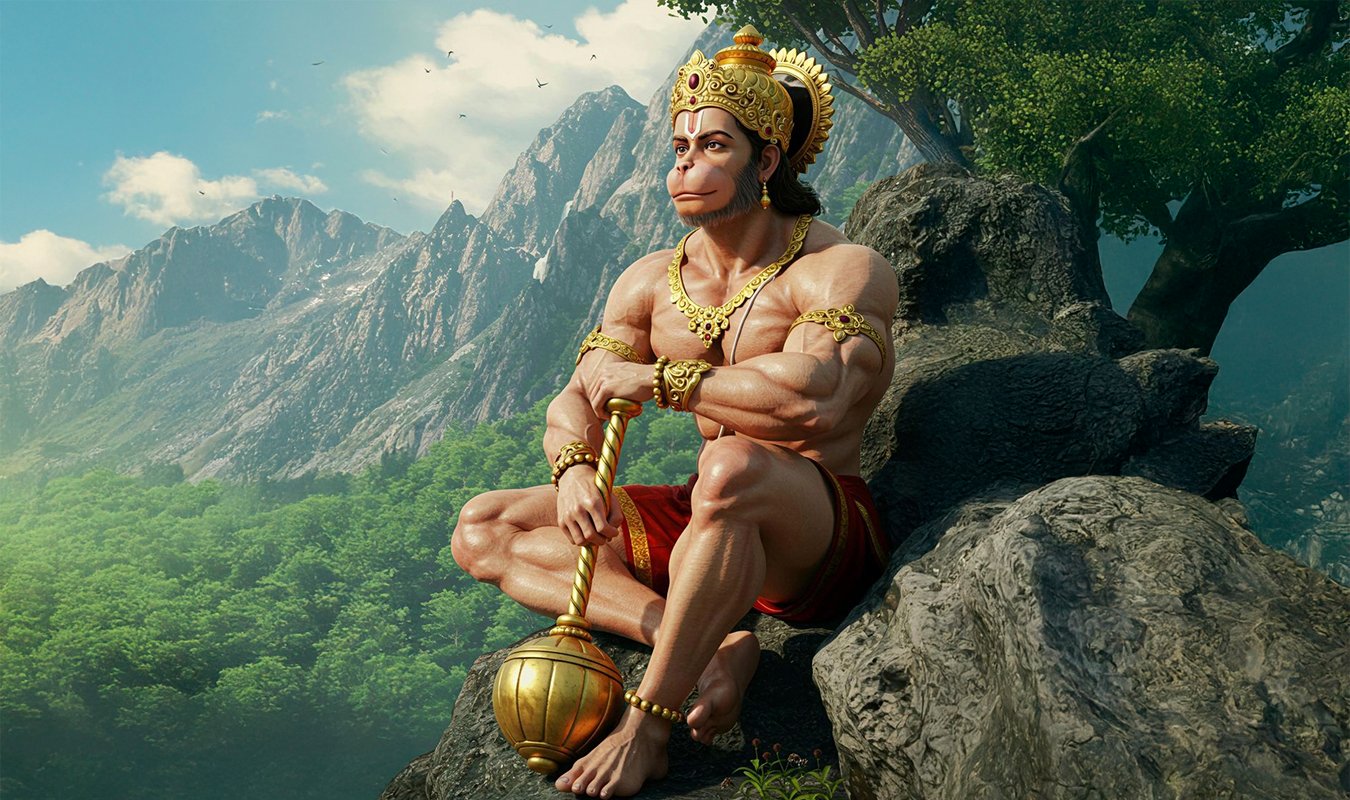

Among all the countless names sung in praise of Lord Hanuman, there shines one title that carries both thunder and tenderness — “Veer Hanuman,” the warrior of divine devotion.
He is not just a figure of immense strength; he is the living symbol of courage guided by faith.
To the fearful, he offers protection.
To the weary, he offers energy.
To the lost, he offers the reminder that power without humility is empty.
To the fearful, he offers protection.
To the weary, he offers energy.
To the lost, he offers the reminder that power without humility is empty.
Every temple that holds his idol painted in red sindoor tells the same tale — of a being who could crush mountains yet bow like a child before Lord Rama.
In the ancient Sanskrit texts, he is called “Mahaveer,” the great hero, and his story teaches us that the greatest bravery does not come from muscle or might, but from surrender.
This article explores the journey of Veer Hanuman — the fearless protector, the humble servant, and the eternal inspiration for all who wish to live with courage and compassion.
The Unshakable Strength Born from Surrender
“Veer Hanumanam vande, yo bhaktānām abhaya-pradah।”
“I bow to the valiant Hanuman, who grants fearlessness to his devotees.“
“I bow to the valiant Hanuman, who grants fearlessness to his devotees.“
The Humble Beginning
Born to Anjana Devi and Vayu Deva, the wind god, Hanuman’s birth itself was a divine act. The gods had sent their blessings through the sacred payasam meant for Dasharatha’s queens (the same that gave birth to Rama). A portion carried by the wind reached Anjana, and thus was born a child destined to serve the very Lord he shared essence with — Rama.
Even as a child, Hanuman’s strength was boundless. One morning, mistaking the rising sun for a ripe fruit, he leapt into the sky to catch it. The gods watched in awe — the tiny Vanara soared through space, glowing like gold.
When Indra struck him with his thunderbolt to protect the cosmic order, Hanuman fell to the earth — unconscious. The wind god, Vayu, enraged at his son’s fall, withdrew the air from the world. The universe gasped in silence.
Seeing the suffering of creation, the gods revived Hanuman and blessed him:
“No weapon shall harm you, no fear shall touch you.”
You will live immortal — strong as devotion itself.
You will live immortal — strong as devotion itself.
That was the moment the seed of Veer Hanuman was planted.
The Test of Faith
Years later, when Lord Rama sought to rescue Sita from Ravana, it was Hanuman who became his shadow, his messenger, and his strength.
The defining test came when he was sent to Lanka to find Sita. No army, no companions — only faith.
At the edge of the ocean, the Vanaras debated who could leap across. Each hesitated — until Hanuman, urged by Jambavan’s words, remembered his true nature.
He closed his eyes, invoked the name of Rama, and whispered:
“राम नाम की शक्ति से, कुछ भी असंभव नहीं।”
“By the power of Rama’s name, nothing is impossible.“
“By the power of Rama’s name, nothing is impossible.“
With folded hands, he bowed to the rising sun, pressed his feet to the earth, and soared into the sky like lightning.
The wind roared. The sea rose to greet him. Mountains trembled. Even the gods watched in silence.
That leap — fueled only by devotion — marked the birth of Veer Hanuman, the warrior who feared nothing because his heart belonged wholly to God.
The Warrior in Lanka
In Lanka, Hanuman found Sita in Ashoka Vatika, sorrowful yet radiant in her faith. He offered her Rama’s ring and words of hope. But when demons tried to capture him, he allowed himself to be taken before Ravana.
When the king of Lanka mocked him, Hanuman’s eyes shone like fire.
He allowed his tail to be wrapped in cloth and set aflame — only to turn it into a divine weapon. Leaping from rooftop to rooftop, he burned the golden city of Lanka — not out of rage, but to show that no empire can stand before the flame of truth.
“atra yatra Raghunatha kirtanam,
Tatra tatra krita mastakanjalim.”
“Wherever the name of Rama is sung, there stands Hanuman, palms folded in reverence.“
“Wherever the name of Rama is sung, there stands Hanuman, palms folded in reverence.“
This was not destruction; it was purification. Even fire became a tool of devotion in Hanuman’s hands.
Sanskrit Verse
“वीरं हनुमानं वन्दे यः सदा रामकार्यरतः।
दैत्यभूतपिशाचादीन् नाशयत्येव तेजसा॥”
दैत्यभूतपिशाचादीन् नाशयत्येव तेजसा॥”
Vīraṁ hanumānaṁ vande yaḥ sadā rāmakāryarataḥ,
daityabhūtapishācādīn nāśayaty eva tejasā.
daityabhūtapishācādīn nāśayaty eva tejasā.
Meaning:
“I bow to the heroic Hanuman, ever engaged in Rama’s service, whose radiance destroys demons, ghosts, and darkness itself.”
The Essence of “Veer”
In Sanskrit, “Veer” does not only mean brave — it means “the one whose heart is fearless because it rests in truth.”
Hanuman’s heroism was not born from pride, but from surrender.
He did not fight for himself, but for righteousness.
He did not roar to intimidate, but to awaken courage in others.
He did not fight for himself, but for righteousness.
He did not roar to intimidate, but to awaken courage in others.
When Rama praised his valor, Hanuman folded his hands and said softly:
“Prabhu, I am only your servant. You are the strength in my heart and the fire in my breath.”
Even victory could not make him proud — because he knew his power was divine, not personal.
Veer Hanuman in the Ramayana
After Sita’s rescue and Ravana’s fall, Rama turned to Hanuman and said:
“How can I ever repay you, O Hanuman?“
Hanuman knelt and replied:
“By allowing me to serve you forever, my Lord.
That is my heaven.“
That is my heaven.“
Moved, Rama embraced him — and declared:
“In every age, whenever my devotees call upon me,
You shall appear first to protect them.“
You shall appear first to protect them.“
That divine promise still echoes in temples across India, where Veer Hanuman stands as the eternal guardian.
The Mantra of Strength
“ॐ वीर हनुमते नमः।“
Om Veer Hanumate Namah.
Om Veer Hanumate Namah.
Chanting this mantra is believed to awaken courage, remove fear, and fill one’s mind with the steadfastness of Hanuman.
Temples of Veer Hanuman
Many shrines across India honor Hanuman in his Veer form — powerful, glowing red with sindoor, standing tall with his mace raised high.
Famous among them are:
1. Sankat Mochan Hanuman Temple, Varanasi
2. Salasar Balaji, Rajasthan
3. Veer Hanuman Mandir, Mumbai
4. Namakkal Hanuman Temple, Tamil Nadu
Devotees offer boondi, betel leaves, and oil lamps, believing Hanuman absorbs their prayers as fuel for their strength.
The Inner Meaning — Becoming a Veer
To walk the path of Veer Hanuman is to live without fear, to face life’s battles with faith, and to surrender every action to the divine.
When life feels overwhelming, Hanuman’s story reminds us that true bravery is not in never falling — but in rising each time with devotion.
“A warrior fights for victory.
A devotee fights for love.
Hanuman fought for both — and became eternal.”
A devotee fights for love.
Hanuman fought for both — and became eternal.”
Spiritual Practice — The Veer Hanuman Sadhana
Each Tuesday or Saturday:
1. Light a ghee lamp before Hanuman’s image.
2. Offer five red flowers (symbolizing the five elements).
3. Chant Om Veer Hanumate Namah 108 times.
4. Read one verse from the Sundara Kanda of Ramayana.
It is said that with every repetition, Hanuman’s courage begins to awaken within the heart — silent, glowing, indestructible.
Final Reflection
Veer Hanuman is not just a warrior in battle — he is a warrior of the soul.
He teaches us that devotion can be stronger than destiny,
and that the greatest strength lies not in conquering the world, but in conquering oneself.
and that the greatest strength lies not in conquering the world, but in conquering oneself.
“When the heart bows in faith, even the mountains move.”